James Chang / Work / The Fantastic Leagues / AI Insights
Fantastic Leagues · AI Insights · Last Updated
League-context AI, not generic advice.
Eight AI features generate analysis that reads your specific league — your rules, your rosters, your free-agent pool, your trade history — not a generic playbook. Built on Google Gemini as the primary model and Anthropic Claude Sonnet as fallback, with a shared insights cache that keeps costs & latency tractable.
The core bet
Most fantasy baseball tools surface the same projections to every league: the same rankings, the same waiver-wire picks, the same trade values. But real league decisions aren’t made in a generic category system — they happen inside a specific league’s rules, inside a specific roster’s gaps, inside a specific owner’s trade history. An elite closer is worth more in a head-to-head categories league than in a points league. A keeper pick that looks smart in isolation can be a trap once you know the commissioner’s inflation rate.
The Fantastic Leagues ships AI that has read your league’s config before it answers — so a Trade Analyzer response isn’t a generic 1–10 fairness score, it’s “this trade closes your SB hole at the cost of AVG depth you’ll need for the playoff push in this 12-team H2H league.”
The eight AI features
Each feature reads league rules + current state + historical data before generating.
1. AI Insights (team page)
liveThe flagship feature. On every team page, an AI-generated read of the team’s strengths, weaknesses, and next moves — updated as rosters change.
- League rules (scoring format, keeper rules, roster size, bench depth)
- Current roster with MLB Stats API projections attached
- Current standings and category-by-category deltas vs. other teams
- Recent transactions (trades, waiver claims, drops) from the last 30 days
- Available free agents ranked against the team’s gaps
Output: a paragraph of strategic read + three concrete recommendations with rationale. Triggers on page load; cached per (team_id, data_hash) so a refresh is near-instant.
Prompt excerpt
You are a fantasy baseball analyst. Analyze this team's
ACTUAL STATS below and provide performance insights.

CRITICAL: ONLY reference stats shown in the data below. If a
player shows "0 IP" or "HAS NOT PITCHED", do NOT say they
pitched well. If a player shows "0 AB" or "NO STATS YET", do
NOT comment on their hitting. Only discuss what the numbers
actually show.

[... team data, category rankings, standings, recent moves
     injected here ...]

Provide exactly 4 concise insights based ONLY on the stats above:
  1. Hot/Cold Bats — Which hitters have good or bad stat lines?
     Reference their actual numbers.
  2. Pitching — Which pitchers have pitched and how did they do?
     Who has NOT pitched yet (0 IP)?
  3. Roster Alert — Any players with 0 AB or 0 IP who may be
     injured or not yet in the lineup.
  4. Hot Take — One bold, specific prediction about this team's
     next week. Reference a player's trend.

GRADING RULES — grade MUST correlate with standings position:
  - 1st–2nd place: A- to A+
  - 3rd–4th place: B  to A-
  - 5th–6th place: C  to B
  - 7th–8th place: D  to C
  A 1st-place team CANNOT receive below B-.
  A last-place team CANNOT receive above B+.

Return ONLY valid JSON:
{
  "insights": [{ "category", "title", "detail",
                 "priority": "high" | "medium" | "low" }],
  "overallGrade": "A+ through F"
}
2. Trade Analyzer
liveGiven a proposed trade between two teams, evaluates for both sides. Flags category gaps the trade opens or closes, surfaces the realistic value read (not raw projection value), and gives each side a graded recommendation with reasoning.
Prompt excerpt
You are a fantasy baseball trade analyst for a head-to-head
category league. Analyze this PRE-TRADE proposal and advise
the proposer whether to proceed.

[... trade items + team summaries + keeper warning ...]

Consider these factors:
  1. FAIRNESS: Is the trade balanced in player value?
  2. CATEGORY IMPACT: How does this trade shift each team's
     category strengths/weaknesses
     (HR, RBI, AVG, SB, R for hitters;
      W, K, ERA, WHIP, SV for pitchers)?
  3. POSITION SCARCITY: Does the receiving team need this
     position? Does the sending team have depth?
  4. KEEPER IMPLICATIONS: Are any keeper-eligible players
     being traded? What's the long-term cost?

Return ONLY a valid JSON object:
{
  "fairness": "fair" | "slightly_unfair" | "unfair",
  "winner": team name (or "even" if fair),
  "analysis": 2-3 sentences on trade impact on both teams,
  "categoryImpact": 1-2 sentences on category shifts,
  "keeperNote": 1 sentence or null if no keepers involved,
  "positionNote": 1 sentence or null if not relevant,
  "recommendation": approve | reject | suggest modifications
}
3. Draft Grades
livePost-auction, grades each team’s draft A–F across four dimensions: category strength, risk, upside, and depth. Includes a narrative paragraph per team explaining the grade.
Prompt excerpt
You are a fantasy baseball auction draft analyst. Grade each
team's draft performance A through F.

League Config:
  - Budget: $[budgetCap] per team
  - Roster: [rosterSize] total ([batterCount] hitters,
            [pitcherCount] pitchers)
  - League Avg Spend: $[leagueAvgSpent]

Team Summaries: [injected JSON]

For each team, provide:
  1. A letter grade (A+, A, A-, B+, B, B-, C+, C, C-, D, F)
  2. A 1-2 sentence summary explaining the grade

Consider these factors:
  - Value efficiency: Did they get good value or overpay?
  - Budget management: Did they use their budget wisely, or
    leave too much on the table?
  - Roster balance: Good mix of hitters vs pitchers?
  - Star power vs depth: Did they invest in elite talent or
    spread the budget thin?
  - Bargain hunting: Did they find value at $1–$3?

Return ONLY a valid JSON array:
[{ "teamId", "teamName", "grade", "summary" }]
4. Keeper Recommender
liveFor leagues with keeper rules, ranks which roster players are worth keeping given the league’s salary inflation rate, position scarcity, age curves, and the owner’s keeper history. Not just projection — it accounts for what keeping that player costs in next year’s auction.
Prompt excerpt
You are a fantasy baseball keeper selection advisor. Recommend
which players to keep.

Team Budget: $[teamBudget] / $[budgetCap]
Max Keepers: [maxKeepers]

Roster (with keeper costs = current price + $5):
[injected roster JSON]

Consider:
  - Value relative to keeper cost (is the player worth more
    than their keeper price in an auction?)
  - Position scarcity (especially in NL-only leagues)
  - Player quality, consistency, and INJURY HISTORY —
    discount injury-prone players by 15–30% in value
  - Budget impact of keeping vs drafting fresh
  - Age and multi-year keeper trajectory (younger players
    with surplus value are better long-term keepers)

Return ONLY a valid JSON object:
{
  "recommendations": [{ "playerId", "playerName", "keeperCost",
                         "reasoning", "rank" (1 = best value) }],
  "strategy": "2-3 sentences about overall keeper strategy"
}
5. Waiver Advisor
liveRanks available free agents not by absolute projection, but by your team’s specific need. A ranked SP is only valuable to you if you’re short pitching; otherwise it’s the wrong claim. Every free agent gets a per-team fit score, not a global ranking.
Prompt excerpt
You are a fantasy baseball Waiver Budget waiver bid advisor.

Player to Claim: [name] ([position], [MLB team])
Player Stats: [stats summary]

Team Info:
  - Remaining Waiver Budget: $[teamBudget]
  - League Size: [teamCount] teams
  - Season: [season]

Current Roster at [position]: [players or "None"]
Full Roster Size: [n] players

Consider:
  - Player's value and recent performance
  - Position need (upgrade vs depth)
  - Budget preservation for future claims
  - League competitiveness

Return ONLY a valid JSON object:
{
  "suggestedBid": integer, $0 to $[teamBudget] max,
  "confidence": "high" | "medium" | "low",
  "reasoning": "2-3 sentences explaining the bid recommendation"
}
6. Bid Advisor
liveReal-time during live auction. Suggested max bid on the current nominee based on remaining budget, positional needs, and what other teams have spent so far. Updates as bids come in.
Prompt excerpt
You are a fantasy baseball auction draft advisor for a team in
an [leagueTypeLabel] league. Analyze whether this team should
bid on the nominated player and provide a maximum recommended
bid based on MARGINAL VALUE TO THIS SPECIFIC TEAM.

NOMINATED PLAYER:
  - [name] ([position], [MLB team])
  - Current Bid: $[currentBid]
  - Projected Auction Value: $[projectedValue]
  - Projected Stats: [statsLine]

YOUR TEAM ([team name]):
  - Budget Remaining: $[budget]
  - Open Roster Slots: [openSlots]
  - Position Need: [positionNeed]
  - Current Roster: [roster with positions + prices]
  - Category Strength Scores (summed from rostered players):
    R, HR, RBI, SB, AVG | W, SV, K, ERA, WHIP

ALTERNATIVES STILL AVAILABLE at [position]:
  [list, or "None — this may be the last quality option"]

LEAGUE CONTEXT:
  - [teamsCount] teams, [rosterSize]-man rosters
  - Average Budget Remaining across league: $[avg]

IMPORTANT: The max bid should reflect the MARGINAL VALUE of
this player TO THIS TEAM — not just the generic projected value.
A team desperate for saves should pay more for a closer than
a team that already has two. A team with surplus budget late
in the draft can be more aggressive. Factor in:
  1. Does the team NEED this position/category contribution?
  2. How scarce are alternatives at this position?
  3. Budget math: team needs $1 per remaining open slot minimum.
  4. Is the current bid already above fair value, or room?

Return ONLY a valid JSON object:
{
  "shouldBid": boolean,
  "maxRecommendedBid": integer,
  "reasoning": "2-3 sentences — reference category needs + alternatives",
  "confidence": "high" | "medium" | "low",
  "categoryImpact": "e.g. 'Fills SV gap (+30 SV), but doesn't help SB'"
}
7. Weekly Insights
livePer-team narrative of the week’s moves, scoring-category deltas, and standings movement. Pushed via email via Resend. Opt-out at the team level.
Prompt excerpt
(Same base prompt as AI Insights above, plus weekly-cadence
framing and category movement deltas since last Sunday. Pushed
to each team's owner email via Resend every Monday morning.)
8. League Digest
liveWeekly AI-generated recap for the whole league — all team grades, notable trades, breakout performers, and a trade poll seeded with interesting matchups. The recap goes in the league message board and nudges engagement.
Prompt excerpt — this one has personality
You are a stat-obsessed league member in "[league name]"
writing the weekly digest after Week [n] of the [season]
season ([n] teams, 10-cat roto: R, HR, RBI, SB, AVG |
W, SV, K, ERA, WHIP).

Write with personality — be opinionated, use trash talk, be
specific. Use last names only ("Betts" not "Mookie Betts").
Do NOT use position labels.

IMPORTANT — DATA FORMAT:
The stats below are SEASON CUMULATIVE TOTALS with category
rank in parentheses (e.g., "HR:12(3rd)" means 12 HR total,
ranked 3rd). You do NOT have per-week stat breakdowns.
Do NOT invent or estimate weekly numbers. When discussing
movement, reference rank changes (e.g., "climbed from 6th
to 3rd in HR") — NOT invented weekly stat totals.

[... team data: standings, season totals, rank changes,
     key players, injured/IL, minors, recent moves ...]

CRITICAL RULES (in priority order):

=== ACCURACY (HIGHEST PRIORITY) ===
 1. NEVER invent stats. If you cannot find a specific number
    in the data above, do NOT make one up.
 2. When discussing category performance, cite the CUMULATIVE
    TOTAL and RANK from the data.
 3. When discussing movement, use rank changes — NOT invented
    weekly deltas.

=== INJURIES (HIGH PRIORITY) ===
 4. If a team has a KEY player on the IL, this is MAJOR NEWS.
    It MUST be prominently discussed in that team's commentary.
 5. Players in the minors are dead roster spots. Flag teams
    carrying multiple minors players as handicapped.

=== POWER RANKINGS (STRICT RULES) ===
 6. Power rankings MUST closely mirror the actual standings
    order. Maximum deviation: 2 spots. If a team is #7 in
    standings, they CANNOT be ranked higher than #5.
 7. Commentary must cite 2+ specific numbers from the
    season totals.

=== CONTENT RULES ===
 9. EVERY statement must include specific numbers from the data.
    Never say "crushing it" — say "leads the league with 12 HR,
    ranked 1st."
15. Bold prediction should be fun but grounded in a real trend.

Return ONLY valid JSON:
{
  "weekInOneSentence": "15-25 word headline, must include a
     number from the data",
  "powerRankings": [{ "rank", "teamName",
     "movement": "up|down|steady",
     "commentary": "cite 2+ specific stats" }],
  "hotTeam": { "name", "reason" (3+ specific numbers) },
  "coldTeam": { "name", "reason" (3+ specific numbers) },
  "statOfTheWeek": "2 sentences, exact cumulative numbers",
  "categoryMovers": [{ "category", "team", "direction",
     "detail" (cumulative total + rank change) }],
  "boldPrediction": "1 fun sentence grounded in a real trend"
}

FINAL CHECK: Re-read every sentence in your response. If ANY
sentence contains a number that does not appear in the team
data above, DELETE that sentence and rewrite it using only
real numbers. This is non-negotiable.
Architecture
Two models, one cache, deliberate constraints. Gemini is the primary because latency on the 2.5 Flash tier is consistently good; Claude Sonnet is the fallback because its reasoning quality wins on trade and keeper analysis specifically.
User request
    │
    ▼
Express API (/api/teams/ai-insights)
    │
    ├──▶ Load league context from Prisma
    │      ├─ League rules + scoring format
    │      ├─ Roster + projections (MLB Stats API via MCP proxy)
    │      ├─ Standings + recent transactions
    │      └─ Free agents ranked by fit
    │
    ├──▶ Compute data_hash (SHA-256 of league_state)
    │
    ├──▶ Cache lookup: (team_id, feature_key, data_hash)
    │      │
    │      ├─ HIT  ──▶ Return cached response (< 50ms)
    │      │
    │      └─ MISS ──▶ Inference
    │                    │
    │                    ├─ Primary: Google Gemini 2.5 Flash
    │                    │    (60s timeout, 8KB max output)
    │                    │
    │                    └─ Fallback: Anthropic Claude Sonnet 4
    │                         (90s timeout, 8KB max output)
    │
    └──▶ Store in cache, return to user
The shared insights cache
The cache is the reason this is economically viable at all. Without it, every page load would trigger a new ~8KB inference per feature; with it, only genuine state changes trigger one.
Cache key design
Three-part key: (team_id, feature_key, data_hash) where data_hash is a deterministic SHA-256 of the entire league-state snapshot that feeds the prompt.
When anything that affects the feature’s input changes — a new transaction, updated projections, a roster move — the hash changes, and the next call misses the cache and generates fresh analysis. When nothing changes, every subsequent page load reads the last response from cache in single-digit milliseconds.
Cross-league reuse
A common league config (e.g., 12-team H2H categories with standard Yahoo rules) produces the same data_hash for identical inputs. Two different leagues asking for a Trade Analyzer read on the same two rosters under the same rules hit the cache even though they’re distinct leagues.
Cache lives in SQLite behind the MCP proxy — same machine as the MLB data cache — so lookup is in-process.
Invalidation rules
- Any transaction (trade, waiver, drop) invalidates team-page AI Insights for both affected teams
- New stat period invalidates Weekly Insights + League Digest
- Roster set lock invalidates Waiver Advisor for that week
- Config changes (commissioner edits rules) invalidate everything for the league
- Manual "regenerate" button on each feature invalidates that feature’s cache entry only
Constraints that shaped the design
8 KB output cap
60–90s timeout
Prompt as versioned artifact
Deterministic inputs
Live
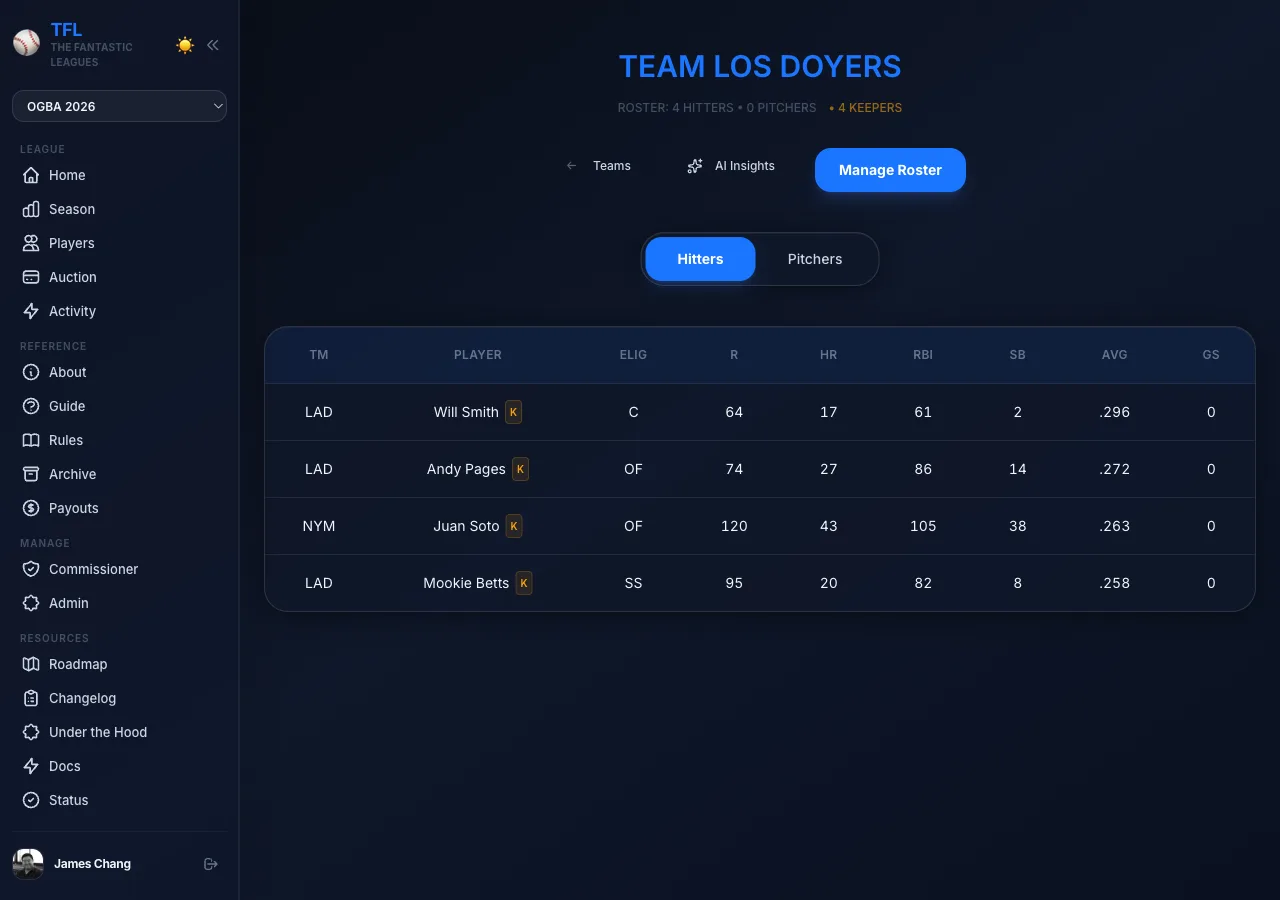
The team-page AI Insights feature in production — inline on every team’s page, regenerated on state change, cached between.